The Public Body and the Officeholder: Two Different Roles
Understand the public body and officeholder distinction: identify who holds continuing duties, who acts in a temporary role and what record clarifies responsibility.
The public body and officeholder distinction matters when a council leader leaves but the council’s services continue. The council remains responsible for its continuing duties; the leader’s successor takes up only the authority attached to that office.
Body and officeholder
A public body is an organisation with public responsibilities, such as a council, government department, regulator or public agency. It continues as an organisation even as its staff and elected representatives change.
An officeholder is the person currently occupying a defined public role, such as a mayor, minister or councillor. The role may give that person power to make particular decisions, oversee work or speak officially, but those powers come from the office and its rules—not personal ownership of the body.
Keep the distinction focused: the body carries its continuing responsibilities; the officeholder may exercise specific powers on its behalf. A council leader can set priorities, for instance, while committees or officials control particular decisions under the council’s rules.
Continuity in public services
Changes of personnel do not automatically end a public body’s existing responsibilities. Services, records, agreements and pending matters remain with the organisation unless the governing arrangements say otherwise. A new officeholder may influence what happens next, but should not be treated as personally responsible for every operational detail.
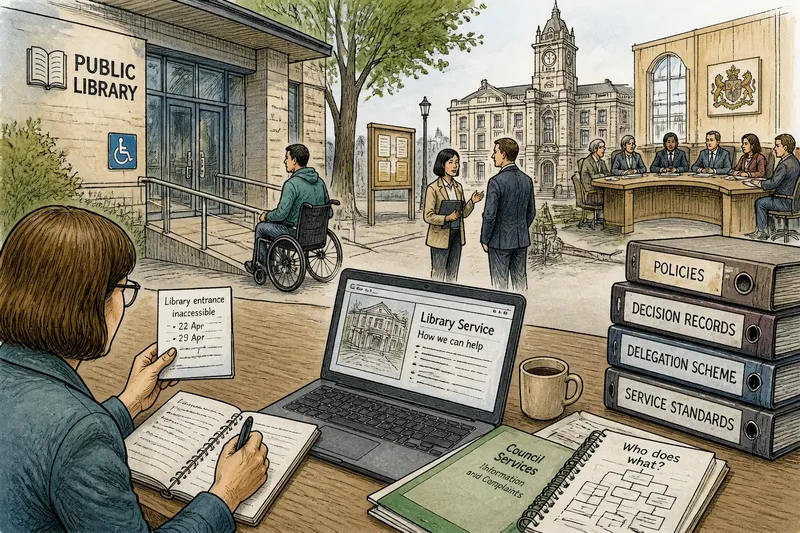
Imagine a resident finds that a public library’s entrance is regularly inaccessible during opening hours. The resident sends the dates and a description of the problem to the council’s library service department, then copies the area councillor. The department can identify who handles the service issue; the councillor can raise it or ask for an explanation. A useful response would name the next responsible role or team, rather than imply that the councillor personally controls the entrance.
Decisions and records
Responsibility depends on the particular action, not just the most visible name attached to an institution. A board might approve a policy, a chief officer might implement it, and an employee might make a case-level decision under delegated authority. Each role can carry a different duty to decide, act or explain.
For a specific decision, check the formal record and the rules that authorise it. Meeting minutes may identify a board or committee decision; a delegation scheme may show which powers an officer can use; a formal letter may name the person responsible for an individual case. An organisational chart can clarify reporting lines, but it does not by itself establish who made a particular decision.
Official language offers clues, not proof. “The department approved” suggests an institutional act, while “the minister announced” identifies a speaker but does not establish who authorised the decision. Look for the record behind the wording before attributing the action.
Quick role questions?
Who keeps a continuing duty?
Start with the public body named in the relevant policy, service information or governing rules. An officeholder may oversee the work, but the duty generally stays with the body unless its rules assign it elsewhere.
Can an officeholder speak for the body?
Sometimes, depending on the subject, setting and authority of the role. Check whether the person is giving an authorised statement, explaining a decision or expressing a personal view.
What changes when an officeholder leaves?
The successor takes up the powers and responsibilities attached to the office, subject to the applicable rules. The change alone does not erase the body’s ongoing duties or show that the successor made earlier decisions.
Where should a service complaint go?
Use the public body’s published complaints route for a service problem, and specify the event or decision. Contact an officeholder as well if their oversight could help, but do not assume that this replaces a required formal complaint.
Responsibility checklist
- Check the service notice or policy for the named public body; if it identifies a responsible organisation, direct the service request there, and if it does not, ask the relevant public office which body handles the service.
- Check the date and description of the event; if they identify a particular incident, include them in your request, and if they do not, gather the missing details before sending it.
- Check the decision record for a named committee or board; if one is named, address questions about the decision to that body, and if none appears, look for a published delegation or ask for the decision-making authority.
- Check the delegation scheme for an officer’s assigned power; if it covers the decision, ask that office for an explanation, and if it does not, seek the rule or record identifying who had authority.
- Check whether an elected representative is being asked to intervene or answer for a formal decision; if the request concerns oversight, contact the representative, and if it concerns a service remedy, use the service department or complaints route.
- Check whether the reply names a next step and responsible role; if it does, keep that reply with your records and follow that route, and if it does not, ask who owns the next action and when you should expect an update.
Say a resident has a dated note that the library entrance was inaccessible on two visits, but no record of who received an earlier report. They identify the council’s library service as the body named on the service page, send the dates and a concise description to that department, and copy the area councillor to request oversight. They then check the reply: if the department names a facilities officer and explains the next action, the resident can follow up with that officer; if it offers no responsible contact, the resident can ask the department to identify one and use the published complaints route if the service concern remains unresolved. The councillor’s involvement may prompt attention, but it does not replace the department’s operational role.
Effort that adds little
It is not worth assigning every service failure to the most prominent public figure. Visibility does not establish control, and repeatedly searching general biographies is less useful than checking the body’s service information, decision record and delegation rules.
Use the public body and officeholder distinction to choose the right kind of request: ask the organisation for a service response, the authorised decision-maker for an explanation, or the record-keeping office for the formal decision. That separation makes it easier to seek action without confusing a public comment with an institutional commitment.