How Public Notices Became Standardised
How public notices became standardised reflects changing records and routines; trace how repeated civic forms preserve decisions and reveal what institutions value.
How public notices became standardised is a story of institutions learning to repeat and preserve civic decisions. As councils and public services took on recurring duties, they needed notices that could be issued in familiar formats and kept as records.
The form was never just a page design. Its headings, sequence and recurring phrases reflected what an office considered necessary to tell the public—and what it needed to remember internally. Reading those features as historical choices helps explain both their usefulness and their limits.
From announcement to record
Before offices relied on shared templates, public information could take different forms: a posted announcement, a printed circular or wording copied into a register. Repeated tasks encouraged clerks to reuse language and arrange details in a dependable order. Over time, those habits could become local conventions, even when no single moment marked their creation.
As administrative work expanded, a recurring format helped connect the message seen by residents with the record kept by the institution. A dated notice could document what was announced, while a consistent heading helped staff sort and retrieve related papers. The form served both a public purpose and an archival one.
What standardisation preserved
Standard forms made certain distinctions more durable. A notice might separate an announcement from a request for applications, or a temporary restriction from a permanent change. Keeping those categories visible helped an organisation repeat its own procedures and gave later readers clues about how a decision had been presented.
But the record is selective. A form preserves the information its designers chose to make routine; it may omit local knowledge, disagreement or the reasons a decision was made. A familiar template can therefore show how an institution communicated without telling the whole story of what happened.
When looking at an old notice, pay attention to its structure as well as its wording. Ask which details have a dedicated place, which appear only in handwritten additions, and which are absent. Those choices can reveal what the office treated as settled, exceptional or outside the form’s scope.
Reading an old notice
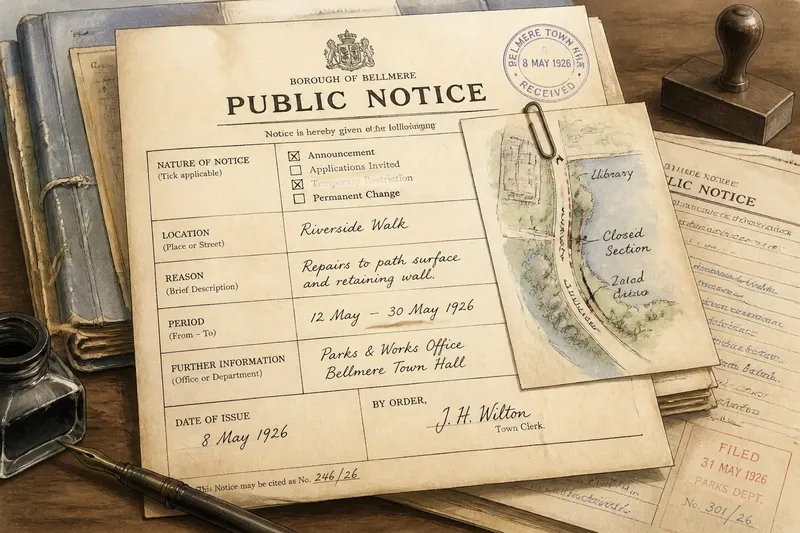
Imagine an invented archive containing a notice from a fictional borough, Bellmere, announcing that a path beside its library would close for repairs. The notice has a printed heading and blank fields for the location, reason and dates; a clerk has added “Riverside Walk” by hand and attached a small route sketch.
A reader comparing the printed form with those additions can distinguish the institution’s standard procedure from the information needed for this particular place. The sketch suggests that the form alone did not convey the route clearly. If the archive also contains a later version with a revised location field, the change may indicate that staff adapted the record after encountering that gap. It would not, by itself, explain why the revision was made.
This kind of reading avoids treating a form as a transparent account. The printed structure tells you what the organisation routinely recorded; annotations and revisions show where a particular event required more. Dates, issuing offices and filing marks can help establish how a notice moved through the institution, though they cannot replace other evidence about the decision.
Clues in the layout
Look for these features when examining a standard public notice:
- Repeated headings: If the same heading appears across notices, treat it as evidence of a shared category; if wording varies, compare the surrounding details before assuming the notices concern the same process.
- Blank fields: If a form reserves space for a date or location, identify that as information the office expected to record; if the space is empty, do not infer the missing detail.
- Handwritten additions: If notes or corrections appear, distinguish them from printed wording; if their author or timing is unclear, leave that attribution unresolved.
- Dates and stamps: If issue or filing dates are present, use them to place the document in sequence; if they conflict, record the discrepancy rather than choosing one without support.
- References to other papers: If a notice cites a plan or resolution, seek that document for context; if it is absent, describe the limit of what the notice establishes.
- Changed terminology: If a later form uses different names for places or processes, compare the versions; if the change is unexplained, treat it as a clue rather than proof of a policy shift.
It is not worth the effort to infer a sweeping institutional story from a decorative border or one familiar phrase. Focus instead on recurring fields, amendments and links to other records. Those are more useful clues to how the form operated.
What can the record tell you?
Why did institutions reuse notice forms?
Repeated forms gave staff a familiar way to prepare recurring announcements and preserve copies in a recognisable order. They also carried earlier administrative choices forward, whether or not later users reconsidered them.
Can a standard form explain a decision?
A notice can show what the organisation publicly stated and what details it recorded. It usually cannot explain the full reasoning behind a decision without supporting minutes, correspondence or other records.
How can I compare different versions?
Set the versions side by side and compare headings, fields, handwritten changes and references to other papers. Note what changed and what stayed constant, but do not assign a cause unless the record supports it.
Forms as public memory
Standardisation helped institutions make recurring communications legible to their own staff and, sometimes, to the public. It also shaped what could be easily retrieved later: a detail given its own field was simpler to record consistently than one left to incidental prose.
How public notices became standardised is therefore not only a story of convenience. It is also a way to see how civic memory was organised—what offices chose to preserve, how they classified events and where a particular case strained the inherited format. When you encounter an old notice, read its blanks and alterations as carefully as its printed words; the exceptions may show where the institution’s routine met the particular life of a place.