Reading a Meeting Agenda Before You Take Part
Reading a meeting agenda helps you spot decision points, missing context and relevant papers, so you can focus your preparation on what members may do.
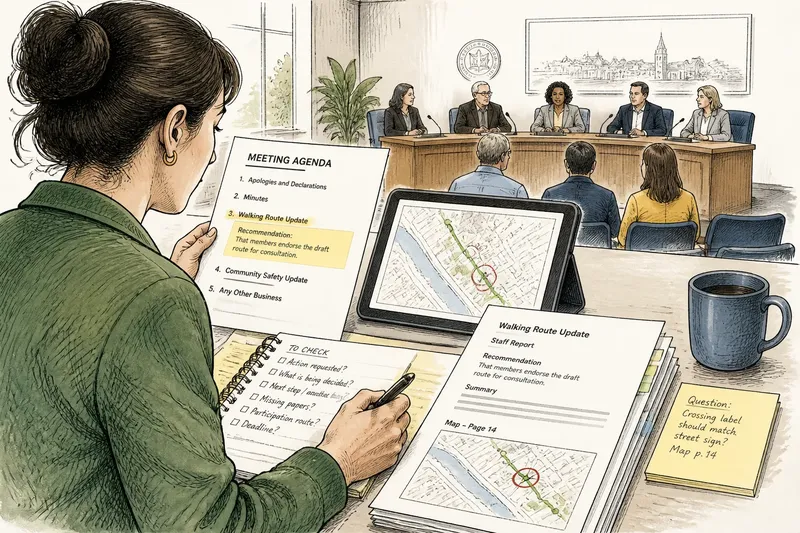
Read the recommendation beneath a meeting agenda item before deciding what to say about it. The heading may name a broad subject, while the recommendation reveals whether members are being asked to approve a proposal, receive an update or send advice elsewhere.
That distinction helps you prepare for the substance of the meeting rather than guess at its likely outcome. Treat the agenda as a map of the business, then use the linked papers to identify the questions its wording leaves open.
Read the requested action
Start with the meeting title, the public body’s name and its stated remit. A planning board and a council committee might discuss the same building, but their roles may differ: one could decide an application, while the other offers advice. Check the meeting page or the body’s description if its authority is not clear.
Next, read the full item and any recommendation beneath it. A heading such as “community safety” identifies a subject, not an action. The recommendation may ask members to adopt a policy, note a report or refer a proposal for further work.
Pay attention to verbs, but do not read them in isolation. “Consider” may leave the outcome open; “endorse” may not mean formal adoption; “defer” suggests that action is postponed. Local rules determine the procedural effect, so ask the meeting clerk when a term matters and remains unclear.
Trace the decision path
An agenda item can be one stage in a longer process. Look for references to a recommendation, referral, consultation, draft or later report. These clues can show whether the current body is deciding, advising or preparing material for another body.
Record the next step the papers actually name. If the item points to a later decision, note which body or process is involved and what information is expected to return. Avoid treating a discussion or endorsement as a final outcome unless the agenda and papers say so.
Check the supporting papers
Open the staff report, draft policy, map or application linked to the item. Read the recommendation and summary first, then follow the sections that explain options, impacts and consultation. A map may clarify the affected area; an appendix may answer a specific question the summary leaves open.
If a link fails or a paper is missing, search the meeting page for a separate documents tab or a revised agenda. When contacting the meeting office, give the item number and exact attachment title. Ask whether the paper is available and whether it is expected before the meeting.
Do not infer an absent report’s contents from a short heading. Instead, write down what you need to know: the action requested, the options considered, or what evidence will be available before a later decision. That gives you a focused question even if the papers have not arrived.
When does a meeting agenda matter?
Does the agenda item ask for a vote?
Look for an explicit recommendation to approve, adopt, authorise or reject something, and check the accompanying report for the exact motion. A vote may concern minutes or procedure rather than the wider subject named in the heading.
What does “receive” or “note” mean?
These words often mean members are being given information rather than asked to choose an option. Check whether the item names a follow-up report or later decision before deciding how much preparation it needs.
Can the public comment on an item?
Read the agenda’s participation notes and the meeting page for instructions on written submissions, speaker registration and deadlines. If they do not explain whether comments are accepted on this item, ask the clerk or meeting contact rather than assuming that attendance includes a chance to speak.
Could the item be considered with others?
Labels such as “consent” or “en bloc” can mean several items are handled together under the body’s rules. Check whether members can separate an item for discussion and whether the public has any role in that procedure.
Choose a useful contribution
Focus on a point the body can still consider: a local impact the report overlooks, an assumption that needs explaining, or a question about how a proposal would be carried out. Tie your point to a page, map or sentence in the papers so members can see exactly what prompted it.
Say you are preparing for a neighbourhood transport committee. Its agenda calls an item “walking route update”, and the report asks members to endorse a draft route for consultation. You notice that the map labels a crossing differently from the street sign residents use. You note the map page and crossing location, then ask whether the label will be corrected before consultation. The resulting question addresses the draft’s accuracy without treating endorsement as a final route decision.
- Check whether the heading names a topic or the recommendation names an action; if the action is explicit, prepare for that decision, but if not, read the report before drawing a conclusion.
- Check whether the recommendation says “approve” or “adopt”; if it does, identify what members would be approving, but if it concerns procedure or minutes, do not frame it as a decision on the wider issue.
- Check whether the item says “receive” or “note”; if so, look for a follow-up date or report, but if no next step is named, ask what further action is expected.
- Check whether a paper, map or attachment is missing; if it is, request the named document, but if it is available, use its relevant page to support your question.
- Check whether the papers identify another body or later stage; if they do, record that destination, but if they do not, ask whether the current body expects to act itself.
- Check the participation instructions for a written-comment route, speaker arrangement and deadline; if a route and deadline are stated, follow them, but if they are unclear, contact the meeting office before preparing a submission.
- Check whether an item is grouped with others; if the rules allow it to be separated, find out how, but if they do not, keep your point concise and relevant to the grouped business.
Plan around meeting timing
Agenda order does not always tell you when an item will be heard. Earlier business may take longer, and the chair may change the order under the meeting’s rules. If you can attend for only one item, check whether the clerk can clarify the likely timing and how changes will be announced.
It is not worth reading every attachment from beginning to end before you know what members are being asked to do. Start with the recommendation and summary, then read the documents that answer your particular question. This keeps preparation focused without mistaking a brief heading for the full story.
Keep a preparation note
Make a compact note with the item number, requested action, one question and the document page that supports it. Add the next stage if the item refers elsewhere, and note the stated route and deadline for public input. If the agenda only reports progress, keep track of the promised follow-up rather than preparing as though a vote is imminent.
For a quick meeting agenda check, return to the exact wording of the recommendation whenever the papers or discussion make the item seem broader than it is. That small habit keeps your contribution tied to what the body can actually consider.